Posts

Pleasures and suffering
Image
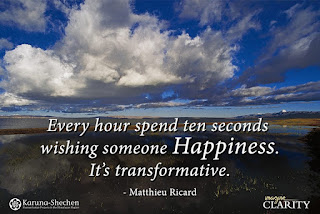
Are our quest for for pleasures i vain? Is fame in vain? Is likes and selfies in vain? Mattieu Ricard, the Buddhist monk born in France, quotes an ancient Tibetan master; Drinking, dancing, singing, and the pleasures of the flesh never fully satisfy.  First, those pleasures do not satisfy both the body and mind. Second, they depend on external circumstances over which we never have complete control, and as such are not always immediately available whenever and wherever we want them. [...] On reflection, pleasures are the cause of great frustration and repeated suffering. [...] However, the happiness provided by the Dha rma is quite different. It permeates the body and mind at all times and in all circumstances. [...] No enemy and no event can take it away from us, and its benefits continue into our future lives. That is why it is an ultimate goal to achieve." Asanga, extract from gdams ngag rinpoche'i mdzod, compiled and edited by Jamgon Kongtrul Lodro Thaye (...
Existential-bio-Buddhism

Image
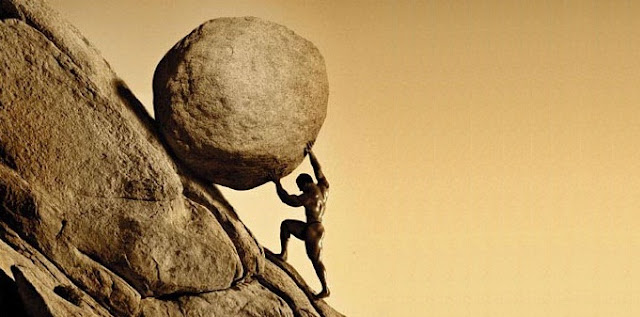
What is that? Is it really possible to combine existentialism with biology and Buddhism. David Barash, professor at the University of Washington, anyway tries it in his book "Buddhist biology: Ancient eastern wisdom meets modern western science". He means that the three subjects are comparable, though not the same. By combining them it will take away the fundamental parts in each of them. For example the worship of Buddha as a God. From existentialism he takes the example from the essay "The myth of Sisyphus" by  Albert Camus. Sisyphus is is condemned to forever push a boulder up a mountain. But when the boulder comes to the top it rolls down again. And Sisyphus has to start it all over again. It's an absurd task that Camus means is our destiny. To act without a meaning and a real goal. We will all die and there is no God or eternal truth to save us. Buddha had about the same view of life, at least if we are completely driven by our desires. If...

Do we live in a post-truth era?

Image
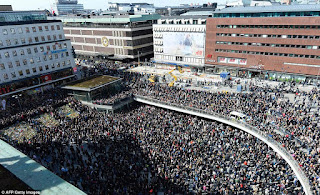
There has been a terrorist attack in the center of Stockholm. The day before I walked in that street. The terrorist, with connection to ISIS, wanted to start chaos and disharmony in our society. But he was also unemployed and stayed here without permission. In the last time he mostly "smoked and slept", according to himself. So probably he was depressed and probably angry because of the decision about expulsion  from  Sweden. So the attack was just partly motivated by religion, and just by a small part or Islam,  Fundamental Islamism. Two Swedish Muslims arranged a peace meeting just some days later - and so many came. If we had a dictatorship here, the dictator probably had used the  opportunity to accuse the whole Islamic society for the attack. Our government wont do that. But Timothy Snyder warns in his book "On Tyranny" about this scenario. Because it has happened before. Here is his message in a minimal package: Yuval Harari doesn...

We can't go back

Image
In a TED-dialog Yuval Harari explains why we in the future have to have some global administration or even leadership. Two of the biggest problems in the future will be climate change and artificial intelligence. The poorest countries will be the ones that will suffer most of both the threats. AI will probably make millions of people without a job. The jeans made in Pakistan that I recently bought (they are "eco-friendly") will soon be made by machines. The trucks will soon find their way without drivers. And what will then happen to the truck drivers? The economy are already global and cannot be regulated by national laws. And the greenhouse gases are mainly produced by the rich countries. So we need some global leadership. And that will probably not be a democrat or elected one, according to Harari. But he seem to mean that it no other way to solve the coming problems. I´m sure he's also influenced by trend he has written about; The world is gett...

Fingers, ice and octopuses - what a mix!

Image
Its getting warmer in Stockholm. The ice paints nice art together with the water which can be seen from the many bridges. Of course the ice cannot choose the form of the paintings. It's depending on the wind, the temperature and the water etcetera. But how much can we choose? It seems to be so that the length on the fingers indicates how much serotonin you got in  your mothers womb. Though this statement is must be taken generally and not for everyone, and it can change when we learn more. But it seems whe cannot choose to be heterosexual or homosexual. But even in some countries in Europe, as Macedonia, its very hard for homosexuals. We are somewhat programmed. We cannot choose much of our talents and our personality. In that sense we are like the ice. When Dewey Redman, the saxophonist, visited  John Coltrane he saw Coltrane's long fingers and they started to have a conversation about fingers and saxophone skills. You cannot change the length on your...

To face the way it is - Vipassana

Image
Yuval Harari has practised Vipassana meditation for 15 years. He means that it is because of this  practise  that he has been able to write  two very interesting books. They have even sold very well. The first is about our history in the long run and the other about a possible future for us. The meditation has helped him to remove some trash from his mind. We are all loaded with ideas, preconceptions and so on.... But to face the way it is can be hard. Harari saw the dark side of the meat industry and became a vegan. He faced this very cruel reality which he calls one of the biggest crimes in our time. And he also become clear of that things like humanism, liberalism, Christianity and so on just are stories or ideas, they can be good or bad. But we may have things like religion or spirituality to decide if  it's good or bad. Anyway science doesn't care about ethics. Harari's own way of  thinking about ethics is to decide if an action causes suffe...

Annie Dillard

Image
Two quotes from her book For the Time Being(1999):  There is now , living in New York, a church sanctioned hermit, Theresa Mancuso, who wrote recently, "The thing we desperately need is to face the way it is." When a person arrives in the world as a baby, says one Midrash, "his hands are clenched to say, 'Everyting is mine. I will inherit it all.' When he departs from the world, his hands are open, as though to say, ' I have acquired nothing from the world.'"  ( In Judaism, the  midrash  is the genre of rabbinic literature which contains early interpretations and commentaries on the Written Torah and Oral Torah) Thank you Annie