Posts

We have the future in our hands

Image
 The title comes from a talk by Martin Rees, the English astronomer, in Stockholm, some years ago. What he means is that we now can change the world a lot. Because of our interaction with high tech we can evolve much faster than evolution. I guess that includes AI. The sun will shine for many years ahead and future human will look very different from now. Its in the end of this long lecture that Rees speaks about the future of the Earth.  Before that he speaks about the emergence of more and more complexity in the life on Earth.  Let us at least hope that we can use these abilities to fight climate change and the sixth mass extinction.  We will  in the future for sure have abilities to do that.  We need politicians that are not afraid of being unpopular.  And we need a new story than the one of new-liberalism.  Adam Curtis shows in a a documentary that new-liberalism is a way to cool down the masses by consumerism. That seems to be the way many co...

Stars made life possible - globalization may make peace possible

Image
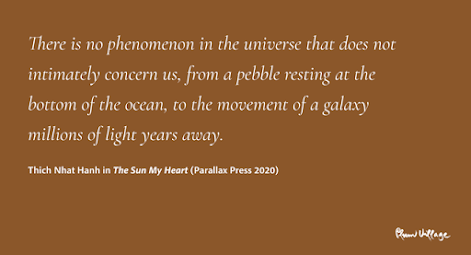
 This is not astrology, stars doesn't decide our destiny.  But stars gave us the elements for life because of their lifecycle.  Dying stars gave us carbon. Carbon was not there from the beginning.  And exploding supernovas gave us other elements, that now has created complex life on earth - and us too.  This is remarkable, as if the universe had a plan.  So this may give us hope for the future, maybe there is more to come...  Even our own sun will create carbon in the end of its lifecycle.  Right now it creates helium out of hydrogen.  That's the light that shines on us. And without that light, no life...  The universe is growing, is expanding and is still creative.  We should not fear old age and death, out of that will new things grow.  I sure humankind is evolving too.  Earlier generations gave us knowledge - also by their mistakes.  There is more democratic, or quite democratic states now than ever before.  D...

Hope - for whom?

Image
 What gives us hope? It depends of, hope for whom?  For you or for humankind Or maybe for the earth Or maybe for the universe as a whole... Right now it seems that humankind is in a dangerous situation, Lauri Anderson puts it this way; " Humankind has not lived on this Earth for ever, so we cannot take for granted that we will in the future. Its not hard to imagine the Earth without humans". So, if we have a non-anthropocentric view, we can wish for the Earth to have a healthy life, with or without humans.  This can be seen as sad view if we are a human being, but if we are wolf or a tiger or an elephant it would be an event to celebrate.  Is it possible to have  non-anthropocentric view? Maybe not totally... But as Laurie Anderson (a Buddhist practitioner) says;  I think its possible to image the Earth without humankind. It has been like that before... But first of all it would be reasonable to hope for a future where humankind could cooperate with the res...

A new story for the new world

Image
 The liberal democratic story, with free will and the individual in focus may not work any more. As Yuval Harari points our will is guided by our desires and we cannot choose our desires. In the future AI will now us more than we know ourselves. We already get information and advertises on the net that are there because of our interests or  what we googled on before or what we had bought.  AI can be a far more dangerous technology in the future were we can be hacked by companies or dictators. A new big story may be produced slowly and from many sources.  It may hopefully not be superstitious but grounded in science.  It may be aware of that we are dependent on mother earth, nature and other people.  Or a more dark story will be that technology will save us, for instance by travelling to other planets or by never living forever with the help of computers.  Anyway we cannot look back. Harari meditates every day and goes every year for long vipassana retr...

some things are more or less permanent - for instance information like this

Image
 For instance life and knowledge.  Some bacteria has lived  on earth for more than 3 billion years. They divide and lives on and on and on.  Well more complex life forms have been her for a long time too - even if humans have not...  Knowledge is in fact very resilient - as long as there are books or internet or storytelling  An example from Shakespeare's Sonnet 18:                                                  So long as man can breathe, or eyes can see                                                      So long lives this, and gives life too thee This information from Shakespeare has been around for hundreds of years ...

Simone Weil

Image
  There Comes If you do not fight it---if you look, just look, steadily, upon it, there comes a moment when you cannot do it, if it is evil; if good, a moment when you cannot not. This are words by Simone Weil, from a Christian viewpoint, but it could have be written from a practitioner of meditation (she was interested i Mahayana Buddhism too. Grace fills empty spaces, but it can only enter where there is a void to receive it We must continually suspend the work of the imagination in filling the void within ourselves." "In no matter what circumstances, if the imagination is stopped from pouring itself out, we have a void (the poor in spirit). In no matter what circumstances... imagination can fill the void. This is why the average human beings can become prisoners, slaves, prostitutes, and pass thru no matter what suffering without being purified. The test of what is real is that it is hard and rough. Joys are found in it, not pleasure. What is pleasant belongs to dreams. We...

A new interpretation of "Anthropocene"

Image
 The era of mankind.  Clive Hamilton writes about it in his book Defiant Earth. The Fate of Humans in Anthropocene. Hamilton is a professor of public Ethics in Canberra.  He means that  humans have modified the processes on Earth so radically that it has changed the nature forces that regulates the Earth development and forced it to an new geological epoch.  We have to think of what to do to slow down the changes, as climate change. But we have to adapt to what is already there and will affect the Earth in many thousands of years. Can we repair what we have done?  In the end of the book he concludes that only politics can do something about the threats that Anthropocene puts in front of us. We cannot do it individually. Maybe the struggle that will come is the only way to learn how to live in solidarity with the Earth. He means that it is really important that mankind will survive. We are the only creature on the planet that is intelligent and can understan...